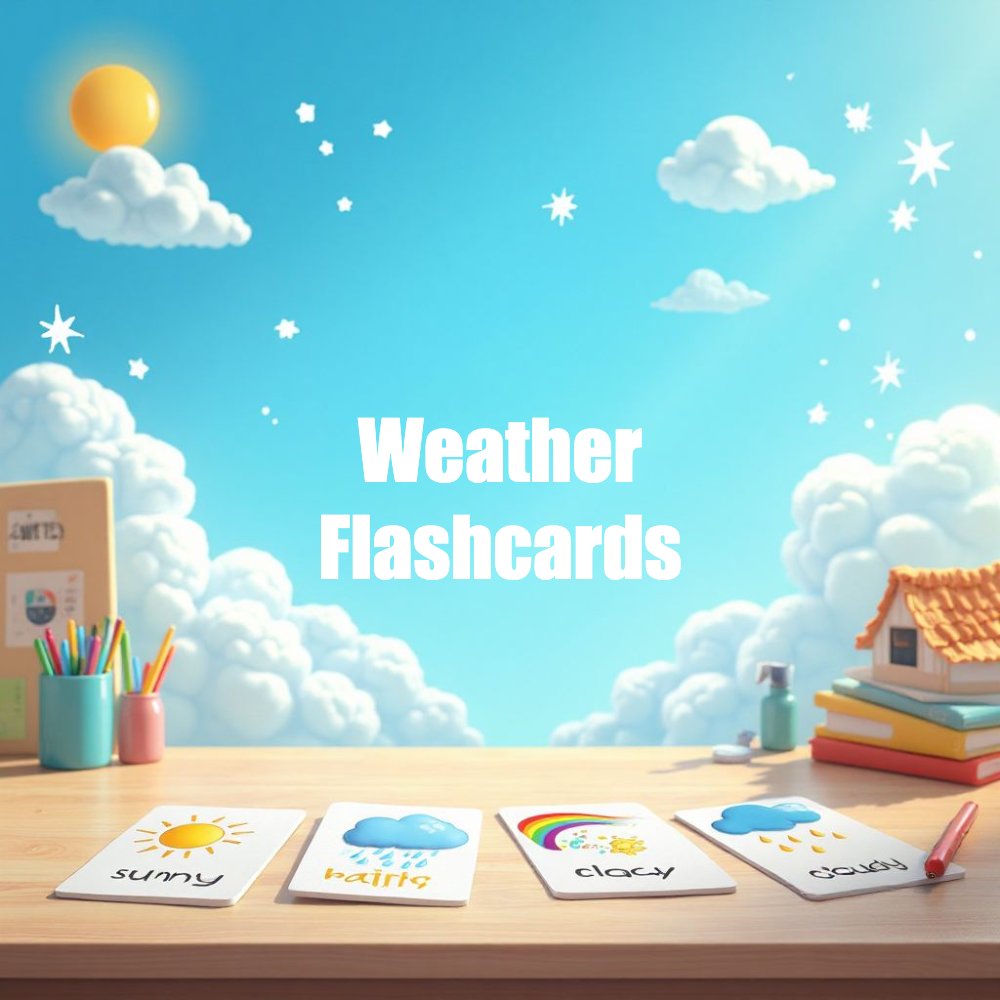
Weather Flashcards
Weather Flashcards turn climate and sky vocabulary into a study deck: sunny, rainy, windy, snowy, stormy, and related terms learners meet in daily English. This page is framed for studying weather vocabulary—not for spinning a random outdoor activity or forecasting tomorrow’s sky. Teachers, tutors, and caregivers can reuse the same short set until recognition is automatic, then stretch into sentences, clothing choices, and polite small talk.
Sample 12-minute lesson arc
Minutes 0–2: Show the window or a sky photo. Ask “What do you see?” without cards. Minutes 2–7: Flip five Weather Flashcards—recognition first (see cue → say word), then one production round (hear word → mime or describe). Minutes 7–10: Learners choose clothing for two of the cards (“coat or sandals?”). Minutes 10–12: Exit ticket—each student says one sentence: “Today it is ___.”
Keep the deck closed during the clothing decision so students retrieve words from memory. If a word collapses, reopen that single card, chorally repeat, and move on—do not restart the whole set. Ending clean matters more than covering every card; unfinished cards become tomorrow’s warm-up.
For hybrid classes, share the Lompu URL and nominate one student as the clicker while others unmute only for answers. Mute chat during recognition so typing does not replace speaking. Substitutes can run the same arc with one device and a sticky note of five target words—cut clothing decisions if energy is low, or add a short mime contest if energy is high.
Recognition → production → clothing ladder
Recognition is cheapest: image or icon → spoken label. Production costs more: spoken label → learner explains the sky or writes a three-word phrase. Clothing decisions add pragmatics: the word has to drive a real-world choice.
Advance difficulty only when recognition is crisp. Rushing to full sentences while the label is still fuzzy creates fossilized errors. For adult beginners, swap clothing for packing-list choices before travel—umbrella or sunglasses, wool scarf or light jacket—so the ladder feels adult without becoming a children’s costume game.
Teachers can layer grammar after vocabulary sticks: present continuous (“It is snowing”), comparatives (“windier than yesterday”), or polite small-talk scripts that use the card as a cue. Keep grammar as an optional top rung; do not make every card a syntax quiz on day one. A quick oral check beats a long written test for early decks.
- Hide supporting hints once recognition is strong.
- Cap young-learner rounds at five to ten cards.
- Celebrate faster recall, not endless “new” words.
- Reuse the same five cards across three short sessions before expanding.
Trauma-aware and climate-sensitive talk
Weather talk can touch disasters—hurricanes, floods, wildfire smoke. Preview cards for your group, allow pass options, and avoid turning severe-weather terms into jokes for learners with recent trauma.
Icons are illustrative, not live radar. Do not use flashcard practice as a substitute for official weather warnings, school closure notices, or travel decisions. If a lesson lands on a severe-weather word during an active alert in your region, switch to a calmer card and revisit later with care.
Invite home-language weather terms as enrichment. Regional climate words and Indigenous seasonal systems may not map one-to-one onto classroom English labels—that is a feature for discussion, not an error to punish. For disaster-displaced learners, skip prompts that force personal storm stories; offer picture descriptions instead.
Study deck versus random pickers and makers
Random activity generators optimize for surprise prompts. Weather Flashcards optimize for repeated study of a vocabulary set. If your goal is “learn the words,” stay in flashcard framing; if your goal is “pick today’s recess plan,” use a different tool.
Build specialized climate decks—monsoon terms, winter sports weather, or bilingual pairs—from the homepage or Flashcards Maker when you need photos and labels the public deck does not include. Compare kinship study patterns on Family Flashcards for session length and partner role-switch ideas.
Homeschool science units can pair a card with a sky sketch journal: after studying “cloudy,” children draw today’s sky and circle the closest match. Libraries hosting storytime sometimes close with two weather cards so caregivers continue the theme on the walk home.
Accessibility tips: describe images for low-vision learners, offer kinesthetic mime alternatives, and keep projected text high-contrast in bright rooms. Spelling follows standard classroom English; say British or American preferences aloud when your curriculum requires a variant.
Home practice that does not feel like homework
Caregivers can run a three-card breakfast flip: one recognition, one production, one “what should we wear?” choice. Keep it under four minutes so it stays playful. After school, reuse yesterday’s cards before adding a new one—stacking novelty every day often erases yesterday’s gains.
Older siblings can coach younger ones by reading the cue and waiting three full seconds before helping. That pause builds retrieval strength better than instant rescue. Travel weeks are natural review windows: flip two cards on a train and invent one silly sentence together—the public Lompu deck travels as a URL with no printout required.
Report this tool
If this page contains abusive, illegal, or rights-infringing material, email contact@lompu.com with the URL and a short description. See also our Terms of Service and the content policy notes on Explore.
Build Your Own Flashcards
Create interactive flashcards in seconds with your own content. Add questions, answers, images, and multiple fields to build personalized learning tools. Perfect for studying vocabulary, reviewing concepts, practicing questions, or sharing knowledge with others. Browse more public decks on Explore, then save and share your own set with a simple link.